
Home / The Class
Striker — 80 kg / 1.25 m
The Striker Class
One class launches the league. Eighty kilograms, one and a quarter metres, humanoid, joystick-driven. Here is what that means in practice.
Class Ladder
Six Classes.
One Running.
The full ladder is published so the sport has a visible growth path — but exactly one class is competitive in 2027. Everything else is roadmap, and we would rather say so than imply a field that does not exist.
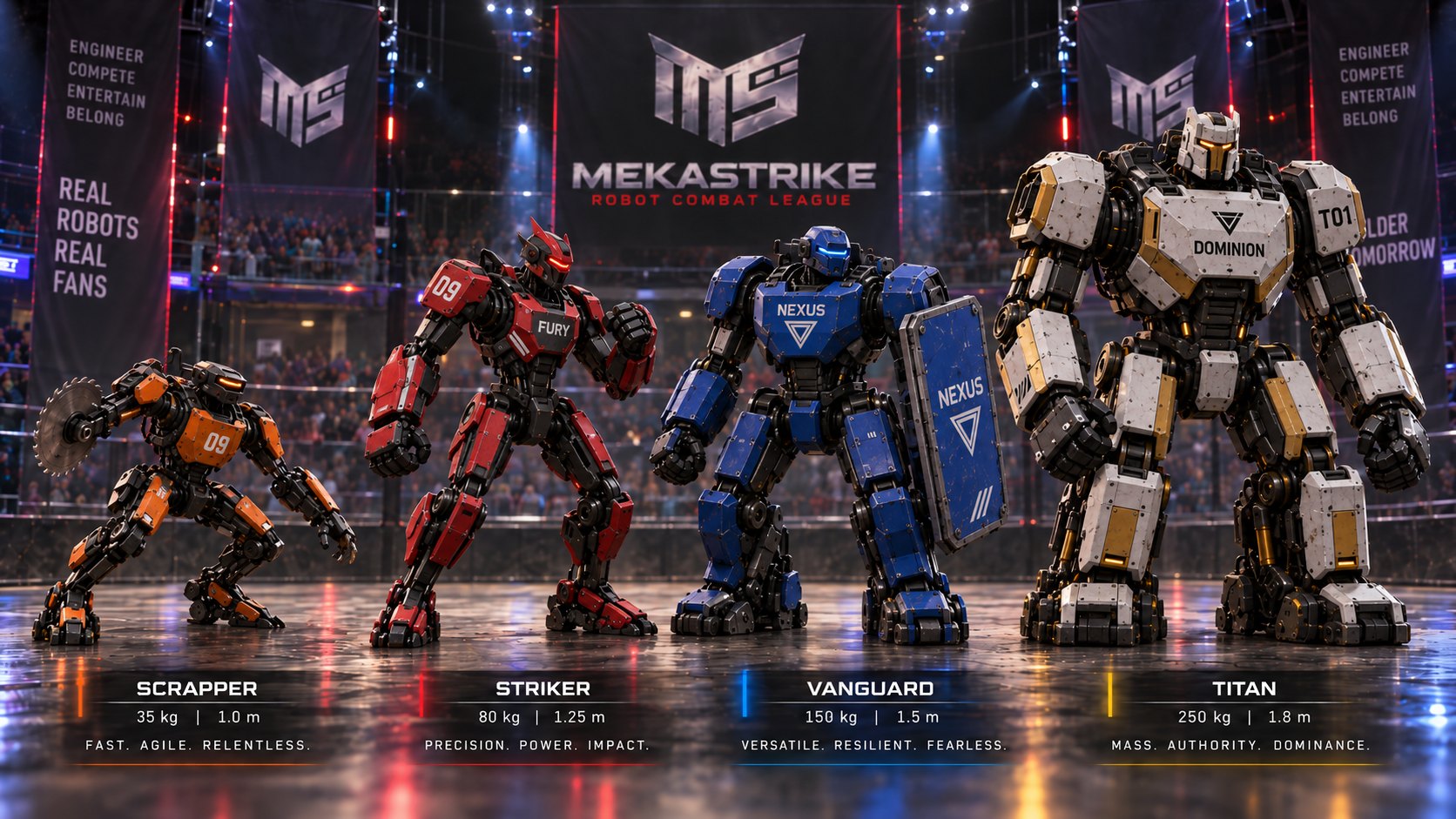
| Class | Weight | Height | Typical build | Status |
|---|---|---|---|---|
| Sparkweight | 15 kg | 0.7 m | $2–5k | Open now — community feeder |
| Scrapper | 35 kg | 1.0 m | $8–15k | Season 2 |
| Striker | 80 kg | 1.25 m | $25–40k | 2027 launch class |
| Vanguard | 150 kg | 1.5 m | $50–80k | Season 2–3 |
| Titan | 250 kg | 1.8 m | $110–180k | Season 4+ — hard ceiling |
| Colossus | 3 m+ | — | — | Exhibition only. Never competitive. |
Build-cost figures are typical ranges for a competitive machine, excluding freight and spares. Sparkweight is a free community feeder class with no entry process — build one, show us. Striker is the class the league launches with, and everything below is about it.
The Limits
80 kg. 1.25 m.
Verified on a Scale.
Classes are enforced by weight, because weight is what you can actually verify at check-in with a scale. Height is a design ceiling, not a check-in measurement.
Eighty kilograms is the number the whole format hangs on. It is heavy enough for a machine to look and behave like a fighter — real recoil, visible body-rock, armour that shears off rather than dents — and light enough that two people can lift it, a team can freight it, and a garage can build it inside a year.
Above that, build costs and lead times climb faster than the spectacle does. Below it, machines start reading as toys on camera.
The Two Artifacts
What Makes 80 kg
Possible At All
An 80 kg humanoid is a hard machine to build in a year. Two things from the league take the two worst problems off a team's critical path — but make no mistake, the robot itself is yours to design and build.
The MekaStrike Control Package
One box of safety-critical electronics, identical on every machine in the field: radio link and receiver, loss-of-signal failsafe, master power link, weapon-lock interlock and telemetry board.
This is the only hardware the league supplies. Everything else — chassis, drivetrain, actuators, arms, armour, batteries, power distribution, structure, cosmetics, the whole machine — is designed and built by the team.
- Safety inspection becomes an integration check, not eight bespoke control-system audits
- One spec sheet covers the entire field for the insurance broker
- Nobody spends build weeks rolling their own failsafe
- Telemetry is consistent across machines, so damage and impact data are comparable
Shipped to every contracted team. Fitting it, and wiring your machine so it can actually cut power and lock the weapon, is a condition of entry.
The Striker Reference Chassis
Robot Zero's lower body, fully documented and published free: CAD, bill of materials with supplier links, build notes and the pitfalls we hit first.
- Removes the highest-risk subsystem from your critical path
- Tracks, suspension, leg towers, battery bays and skid geometry already solved
- Build it, modify it, or ignore it entirely and design your own
- Documented while Robot Zero is being built, not reconstructed afterwards
Publishes early 2027, alongside the builder call. Register to be told when it drops.
Non-Negotiable
Safety Architecture
Provisional — rulebook v0.1 supersedes this page when it publishes. Every item below is already a design requirement on Robot Zero, so none of it is theoretical.
Independent Safety Chain
A certified safety relay monitors the E-stop chain and drops motor torque through a hardwired path. It does not depend on the main computer, the application software, or Wi-Fi.
Arming Plug
A physical arming plug is inserted in the pit immediately before a bout and removed immediately after. Latching mushroom E-stops on the machine and at the arena station.
Deterministic Loss-of-Signal
Loss of the operator heartbeat brings the machine to a deterministic stop requiring manual re-arm. No automatic restart after an E-stop or a power fault, ever.
Enclosed Arena
Gate-interlocked containment. Robot-on-robot contact only, in an empty arena. Wall, frame and floor specifications come from a professional hazard analysis and destructive testing.
Pit Discipline
Two-person rule on an armed machine. Mechanical transport locks on arms and waist. Training fists for all bench work. A pre-round checklist run every single time.
Software Interlocks
No strike primitive with an active temperature or current fault, a missing armour or fist module ID, or during a self-right sequence. Every safety event is timestamped and logged.
The One Line We Do Not Move
A machine that fails safety inspection does not fight. Not for a headline creator, not the night before, not if it costs us a bout on the card. This is the single thing protecting everyone in the building, and it is the one rule with no discretion attached to it.
Rulebook v0.1
Publishing
Late 2026
A versioned living document, drafted from the SPARC and NHRL rulesets rather than written from scratch, and published free before a single builder is asked to commit.
Seven sections, each signed off by both founders:
- Class definitions and check-in procedure
- Safety — failsafe, power link, weapon locks, inspection checklist
- Permitted and prohibited weapons
- Arena specification
- Match format
- Judging criteria
- Team composition and eligibility
Judging
How a Fight Is Scored
Fights end by knockout, immobilisation count, or judges' decision. Where judges decide, three criteria are scored independently.
Exact weightings, round length and count durations are set in rulebook v0.1.